


A degloved face is a very high-consequence injury and an extreme trauma that results in a removal or peeling of skin and the tissue layer from the bone layer, common in cases where accidents have involved heavy machinery or cars. The effect causes a complete deconstruction between tissue and bone, and its consequences are more than skin-deep, with an urgent need to exactly perform surgical processes that can retain tissue and function.
This type of damage requires a concerted and interdisciplinary approach on the part of the surgery team. The damage at this point is not simply physical, as the wound is also very psychological for the survivor and therefore must be treated as quickly as possible to prevent the risk of tissue death and infection that could be life-threatening. As we explore this topic, we will examine the complex reconstructive surgery of reconnecting the face and the difficult process of recovery that follows such a procedure.
What is the medically correct definition of a degloved face
From a medical point of view, a deg loved face is a type of severe avulsion where tissues are ripped away by force from their original attachments. Avulsions are categorized according to their depth and the status of the remaining flap of skin.
The Mechanics of a Degloved Face
A degloved face occurs when a shearing force strips the skin off its attachments, severing the small vessels that fix the skin to the underlying bone. With circulation cut off, the separated skin begins to die in a relatively short period. The surgeons subsequently attempt to reattach those fine vessels by microsurgery; without resumption of blood flow, the tissue darkens and might have to be excised.
Partial versus Total Avulsion
Sometimes, the skin is only partially avulsed, and a small flap remains attached. At other times, the trauma to the face is such that there is a complete avulsion of the face skin. Of course, a total avulsion is considerably more difficult because there is no “bridge” to carry the blood. Surgeons must find healthy arteries and veins to successfully attach it.
Degloved Face Emergency Care
In case of a degloved-face injury, each single second counts; proper first aid will determine whether the tissues of the face can be re-attached.
On-site Immediate Actions
- Control Bleeding: The gentle pressure using clean gauze should be applied at the site of injury.
- Protection of the Tissue: If a portion is completely detached, then it should be kept clean.
- Avoid Direct Ice: Never put the detached skin directly on ice.
- Saline application: Wrap the tissue with saline-soaked gauze prior to placing it in a bag.
- Cooling: Place the bag in another bag filled with water and ice.
These steps help in keeping the cells viable for a longer period, thereby giving a better chance for the surgical team to repair the degloved face.
The Reatttachment Procedure in Surgery
Rehabilitation of a degloved face is one of the most difficult tasks in plastic surgery and requires hours of dedicated work with a microscope.
Microvascular Reanastomosis
This remains the benchmark procedure in dealing with a degloved face. The surgeon reconnects arteries and veins that are less than a millimeter in size using threads that are finer than a strand of hair. This is how it is possible to restore blood supply to a degloved face and regain its pink coloring.
Nerve Repair and Function
Restoration of blood flow is just the beginning. For a degloved face to be fully restored, surgeons must not only rebuild the blood flow but also attend to the nerves in the face and the messages involved in smiling, blinking, and eating. If the nerves are left in this condition, the face can become permanently paralyzed.
Detailed Steps in the Reconstruction Process
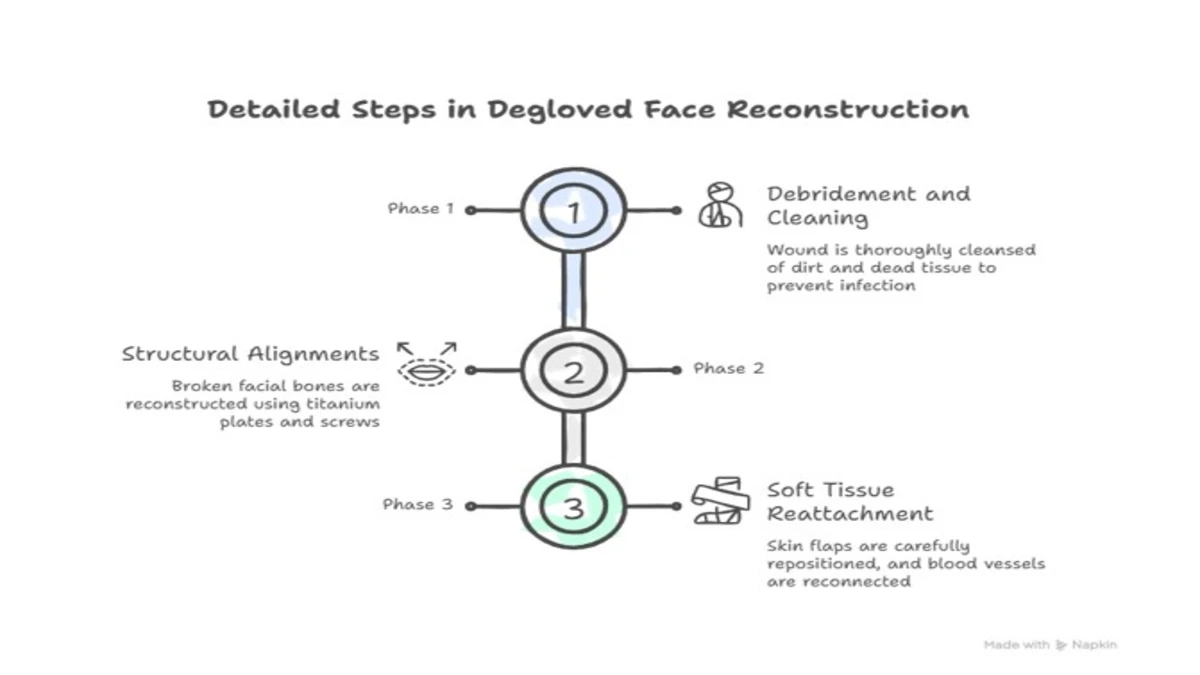 The process of reconstructing a degloved face involves a number of stages and usually cannot be completed within a single procedure.
Phase 1: Debridement and Cleaning
Firstly, the doctors completely cleanse the wound of any dirt and dead tissue, which will cause life-threatening infections. This process involves washing the wound liberally with a healthy amount of sterile fluid to make sure that the area is very clean since that promotes healthy wound healing of the skin. Furthermore, maintaining a sterile environment is vital since that promotes healthy wound healing of the skin. While modern surgical methods focus on human tissue, high-tech enthusiasts often look to the apple watch series 10 to monitor their vitals and health recovery markers during the post-operative phase.
Phase 2: Structural Alignments
Before any skin grafting, it may be necessary to reconstruct any broken bones on the face. Titanium plates and screws are used to reshape the facial skeleton. It provides a solid framework on which to reattach all areas back to their normal location
Phase 3: Soft Tissue Reattachment:
Then, the skin flaps are carefully laid back on the facial structure, and the eyelids, nose, and lips are painstakingly aligned with minute attention to detail. Even the slightest miscalculation can result in permanent disfigurement of the features. Next, the process of reconnecting the blood vessel network commences.
Also read:
Challenges in Recovery from a Degloved Face
The operating room doors shutting do not bring the ordeal to an end. The degloved face injury carries with it enduring obstacles that follow patients long after surgery.
- Tissue Necrosis: Despite the best care possible, not all skin will survive.
- Venous congestion is painful swelling resulting from an influx of blood into the face with inadequate drainage.
- Scarring can be severe, pulling on the eyes or mouth and often requiring additional procedures.
- Psychological Trauma: Many patients benefit from counseling to cope with their new appearance.
Advances in Treating a Degloved Face
Medical science has come closer to providing greater hope to those who suffer from degloving of the face. Newer approaches are making impossible targets realistic.
Leech Therapy
For venous congestion, surgeons often use medical leeches to assist the healing process. They drain excess blood from the affected area, thus helping prevent tissue death. This traditional method remains an important tool in contemporary degloved face recovery.
Hyperbaric oxygen therapy
Patients may also be treated in a hyperbaric pressure oxygen chamber that supplies high oxygen levels to the wounds. This increases the rate of new blood vessel growth and promotes faster recovery with fewer complications.
Ongoing Care and Future Revisions
Recovery from deg loved face injury to the face does not come about from a single operation. The initial surgery is the starting point, with ongoing care entailing vigilant and close monitoring over several periods of time. Physicians look for complications by inspecting the injury site regularly—hour by hour—to ensure that all remains clean and heals. They also regularly check the temperature of the reattached skin. The coolest area usually indicates occluded vessels, and in such cases, the patient may have to go back into the operating room without delay to salvage the tissue.
As technology advances, many experts believe the future of robotics will play a massive role in these delicate procedures, offering even higher precision for microsurgical reattachments.Furthermore, revision surgeries help improve the final look. Revisions also mold the final appearance. Laser treatments soften and fade scars, while fat grafting can help to restore the volume of the cheeks. These adjustments mean a great deal to the patient’s confidence and sense of self.
Conclusion
Surviving a degloved-face injury is the stuff of both state-of-the-art medicine and simple human resilience. These injuries represent some of the most serious and complex ones; however, with microsurgery and committed care, people are able to get their lives back. Techniques continue to be refined by surgeons to improve outcomes for this condition.
Each case represents something different to the medical community in terms of tissue survival. Scars will remain, but the way some functions are regained is a scientific miracle. Above and beyond the steps described thus far, speed of intervention continues to be the mainstay of survival. If ever your life should be put into this kind of crisis, remember: speed counts. Timing is of essence in tissue protection and reaching the specialized trauma center. And finally, ongoing support for research in reconstructive surgery will help individuals with degloved face to recover as fully as possible.
To Get More Updates, Click Here